The Secret to Sourcing Local Properties Up to 47% Cheaper
Property investors searching for their next opportunity could be overlooking significantly cheaper properties much closer than they think. New research suggests that a small change when sourcing local properties could uncover prices up to 47 per cent lower, without having to look far from the original location.
In fact, the difference could be as simple as looking at what’s available on the other side of a postcode boundary.
Neighbouring postcodes reveal significant price differences
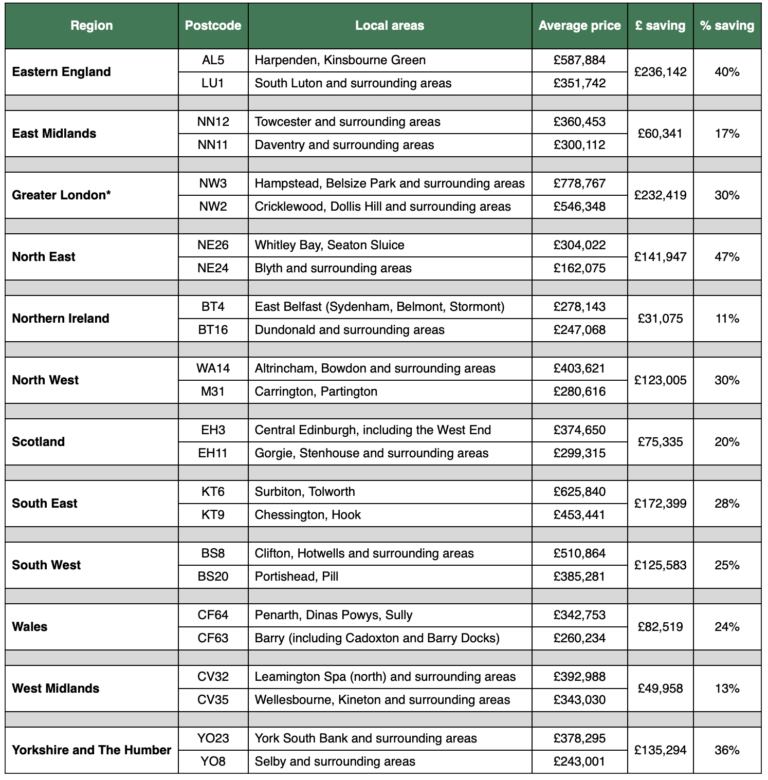
The research compared the most expensive postcode in each UK region with the cheapest neighbouring postcode that shares its boundary. It found that average property prices in the neighbouring locations were 28 per cent lower on average, rising to a 47 per cent difference in the North East.
The largest gap was between NE26, which includes the coastal areas of Whitley Bay and Seaton Sluice, and neighbouring NE24, covering Blyth and surrounding areas.
Whitley Bay is known for its long sandy beach, alongside a well-established leisure and dining scene. Average property prices in NE26 stand at £304,022.
However, neighbouring Blyth is also located on the North East coast. The industrial port town has an extensive coastline and is undergoing continued regeneration, but the average property price in NE24 is considerably lower at £162,075.
That’s a difference of £141,947, making average property prices in the neighbouring postcode 47 per cent cheaper.
Property prices 40% lower in eastern England
For investors sourcing local properties in Eastern England, the research reveals a similar pattern. Neighbouring postcode areas AL5 and LU1 have a £236,142 difference in average property prices.
AL5, which includes Harpenden and Kinsbourne Green, has an average property price of £587,884. In neighbouring LU1, covering South Luton and surrounding areas, the average falls to £351,742.
That makes the neighbouring postcode 40 per cent cheaper – the second-largest percentage difference in the research.
£232,000 difference between neighbouring London postcodes
The contrast between neighbouring postcodes is also apparent in London.
NW3 covers Hampstead and Belsize Park, areas known for their village atmosphere, green spaces and period properties. The average property price across the postcode stands at £778,767.
Neighbouring NW2 includes Cricklewood and Dollis Hill and offers a mixture of period properties and newer developments. Despite remaining in north-west London, its average property price is considerably lower at £546,348.
The difference of £232,419 means average property prices are around 30 per cent lower in the neighbouring postcode.
Property prices 36% lower between neighbouring Yorkshire postcodes
The Yorkshire and The Humber comparison produced one of the largest percentage differences in the research when sourcing local properties. Average property prices in YO23, which includes York South Bank and surrounding areas, stand at £378,295, compared with £243,001 in neighbouring YO8, covering Selby and surrounding areas. That’s a difference of £135,294, or 36 per cent.
Significant differences were also recorded further south. In the South East, average property prices were 28 per cent lower between neighbouring KT6, covering Surbiton and Tolworth, and KT9, which includes Chessington and Hook.
Meanwhile, in the South West, the difference between BS8, covering Clifton and Hotwells, and neighbouring BS20, which includes Portishead and Pill, was 25 per cent.
Cheaper neighbouring postcodes in Scotland and Wales
The research found similar differences outside England.
In Scotland, EH3 covers central Edinburgh, including the West End, an area known for its Georgian architecture, cultural landmarks and proximity to the city centre. Average property prices stand at £374,650, compared with £299,315 in neighbouring EH11, which includes Gorgie and Stenhouse – a difference of £75,335, or 20 per cent.
In Wales, coastal CF64 includes Penarth, Dinas Powys and Sully, where the average property price is £342,753. Neighbouring CF63, covering Barry including Cadoxton and Barry Docks, averages £260,234 – £82,519, or 24 per cent, lower.
Looking beyond the postcode
While the figures show how much average property prices can differ between neighbouring postcodes, the areas themselves are not necessarily directly comparable. Differences in housing stock, local amenities and the character of each location can all play a part.
Amanda Bryden, Head of Mortgages at Lloyds, which conducted the research, said: “Of course, neighbouring areas aren’t always directly comparable and each will have its own distinctive character, housing stock and local appeal. But in many parts of the country, looking just beyond the most sought-after postcodes can reveal more affordable options while still keeping buyers close to jobs, transport links, amenities and the communities that matter to them.”
Published: 18 September 2026


